She Keeps Building
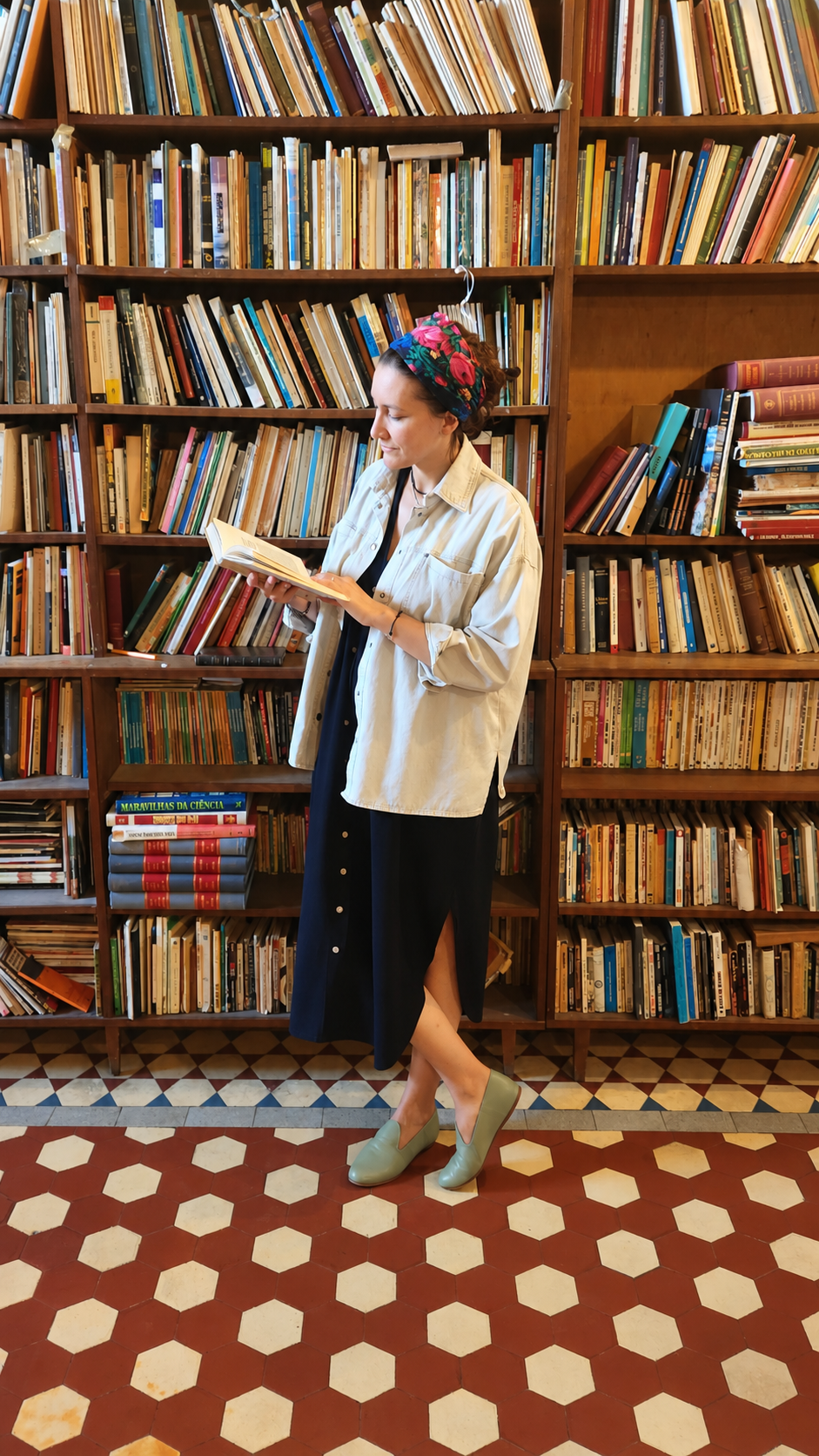
An email about a lost (and eventually found) package introduced us to the woman behind the order. Hajer was so gracious throughout that we wanted to know more about her. She turned out to be the founder of Bairro Arab, a project exploring Lisbon’s overlooked Muslim histories through Instagram and guided walking tours.
Raised in France by Tunisian parents, Hajer moved to Portugal with her husband and their three children when his work brought them there. Settling into her new home, she began noticing familiar words and traces of Arab culture all around her. She followed that curiosity, and now she takes others along, walking Lisbon’s streets and sharing the histories she uncovered.
Getting to know the people who wear our shoes is one of the reasons we love what we do. For She Dreamt It, She Built It, we spoke with Hajer about belonging, family memory, and challenging how history is told.
How did Bairro Arab begin?
When I moved to Portugal, I started learning the language and reading about the country. So many things rang a bell: words coming from Arabic, the names of villages. It triggered my curiosity.
I found a huge amount of academic knowledge, but very little that was accessible to a general audience. Historians and archaeologists had done the work. How come so little of it reached people?
I started an Instagram page sharing what I was reading, words I came across and places I visited. After a few months, people began asking if I could guide them around Lisbon. That’s how the walking tours began.
What discovery has stayed with you most?
At the Museum of Lisbon, I saw Muslim gravestones that had been reused as building material after the community’s expulsion. They were later recovered from the ruins of a hospital destroyed in the 1755 earthquake.
My reaction was almost physical. Here was something tangible left by these people, and it was a gravestone. To me, it felt like a symbol of how this part of history had been buried.
As a Muslim, a daughter of Tunisian immigrants, and now an immigrant myself in Portugal, I found myself wondering: is this what will be left of us here?
There was also something very ironic about it. By taking the stones and reusing them, they had preserved them. They had tried to conceal this history, but the earthquake brought it back to the surface.
In my mind, the tour started with that gravestone. I wanted to follow the story back: who were these people, and what had happened to them?
What does Mouraria mean to the story you tell?
Mouraria means “Moorish quarter.” After the Christian conquest, it was where Muslims lived, under restrictions and segregation.
Centuries later, it became a birthplace of fado, the Portuguese music of longing and melancholy that emerged in the nineteenth century among people living on society’s margins.
When we tell the neighbourhood’s story only through fado, we leave out its earlier Muslim community. And these Muslims were Portuguese. Generations had lived here. They were part of the country. Knowing what happened before changes how you understand the place.
Where do you want to take Bairro Arab next?
I’ve already made a short documentary about Mouraria, and I have ideas for others. I’m interested in looking closely at specific places. You can tell a much bigger story through them.
These questions are now part of my PhD research, too. The research feeds the tours, and the questions people ask on the tours feed the research.
There is so much that could be done through history textbooks, institutions, documentaries, or simply more information in public spaces. I would love to be involved in more work that makes this history known.
How does your personal story inform your work?
I grew up in France, speaking Tunisian with my parents and visiting Tunisia every year, sometimes for long periods. But I never lived there.
As a daughter of immigrants, your relationship with family can be complex. They are your family, but you don’t always know them very well. You hear stories, and those stories change as they pass between generations. Some things are exaggerated, others left out.
I’m interested in how that happens, how memory becomes a story. I know some things I’ve been told are inaccurate, but I can also understand why they were told that way. Sometimes, to keep things together, so that everything doesn’t crumble, you reshape the memory.
That helps me think about how a country tells its own story, too. What does it keep? What does it put aside?
Being Arab and Muslim matters to my work, of course. But growing up as the daughter of immigrants may have shaped these questions even more. I have a very sensitive spot for people being made invisible, for their stories being denied.
Interview by Kenza Fourati. Condensed and edited for clarity.